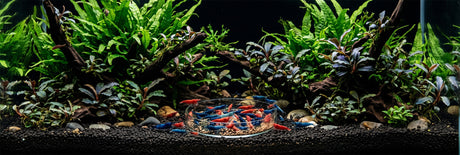
Anyone involved in keeping demanding invertebrates like Caridina shrimp or creating magnificent aquascapes cannot avoid using soil. This active substrate has revolutionized aquaristics. However, as great as the initial advantages are, the day when its effect wears off is equally dreaded.
In this article, you will learn what soil actually does, what variants are available, and how you can avoid the biggest problem – a complete tank restart – with a clever solution from ShrimpPuddle.
What is soil and how does it work?
Unlike neutral gravel or sand, soil is an "active" substrate. It usually consists of natural, baked earth that has been enriched with nutrients.
The magical property: Ion exchange
The main argument for using soil in shrimp keeping is its ability to actively influence water parameters. Soil acts like an ion exchanger: it removes carbonate hardness (KH) from the water and stabilizes the pH value in a slightly acidic range (usually between 5.5 and 6.5). This is the perfect environment for many high-bred shrimp and tropical aquatic plants.
Variants for every purpose:
- Normal Soil: Coarse grain, ideal for layering and strong plant growth.
- Powder Soil: Very fine grain. It is often used as a top layer so that baby shrimp do not disappear into the gaps and fine foreground plants can root better.
- Colors: From deep black (makes the shrimp's colors pop) to natural brown tones for classic scapes.
The big disadvantage: Limited lifespan
Soil is like a battery: eventually, it runs "empty". Depending on the initial water and maintenance rhythm, its absorption capacity is exhausted after 12 to 24 months.
The problem: When the soil is saturated, water parameters suddenly fluctuate, the pH value rises, and the shrimp react with death or a halt in reproduction. The consequence: Previously, this meant emptying the entire aquarium, evacuating the animals, removing the old sludge, and rebuilding everything. An enormous stress for both humans and animals!
The solution: The ShrimpPuddle Soil Background
Why does the soil have to cover the entire bottom if it's only supposed to buffer the water parameters? We at ShrimpPuddle asked ourselves exactly that and developed a solution that makes changing the soil child's play.
The ShrimpPuddle Soil Background
Instead of filling your entire tank with soil, you use a neutral substrate (like sand or fine gravel) and simply hang our Soil Background on the back wall of the aquarium.
Your advantages:
- No more emptying: When the soil's effect wears off, you simply take out the background, empty it, refill new soil, and hang it back in. Your hardscape and plants remain untouched.
- Targeted effect: The soil in the background fulfills its chemical task (pH buffering) without the entire tank becoming biologically unstable.
- Cost-efficient: You need significantly less soil than for a complete bottom layer.
- Appearance: The background can be wonderfully hidden behind plants or mosses and does not stand out in the layout.
Conclusion: Utilize soil advantages, eliminate disadvantages
Active substrate is essential for breeding many shrimp species. But the cyclical stress of a tank restart doesn't have to be. With the ShrimpPuddle Soil Background, you use the water-optimizing properties of soil, while maintaining full control over your aquarium – without ever having to empty everything again.