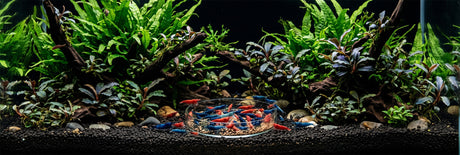
If there's one plant that every aquarium can tolerate and yet never gets boring, it's Java fern. Microsorum pteropus has been a staple in aquaristics for decades – and for good reason. Hardly any other plant so effortlessly combines robustness, adaptability, and design versatility. What many people don't know: behind the term "Java fern" hides an entire family of forms and cultivated varieties that together make up one of the most exciting plant groups in aquaristics.
Origin: Temples, Streams, and Waterfalls of Southeast Asia
Java fern originates from the tropical and subtropical regions of Southeast Asia – Indonesia, Malaysia, Thailand, and the Philippines are among its natural habitats. In the wild, it prefers to grow along streams, waterfalls, and in rocky riverbeds, where it clings to rocks and roots with its fine rhizoids. Submerged, splashed, or partially above water – Java fern grows equally well in all three conditions.
This adaptability has made it a true survivor evolutionarily. In the aquarium, this means: it makes hardly any demands, forgives mistakes, and continues to grow where other plants have long since given up.
Water Parameters: The Absolute Generalist
Java fern is one of the most tolerant aquarium plants when it comes to water parameters. Its only real weakness: its rhizome must never be buried in the substrate. If you keep that in mind, you can hardly go wrong.
- Temperature: 18–30 °C – even tolerates short periods above or below this
- pH-value: 5.0–8.0 – works equally well in soft and hard water
- Light: Low to medium – strong light promotes algae growth on the leaves, no CO2 necessary
- Fertilization: Java fern absorbs nutrients through its leaves, not its roots – a simple liquid fertilization is completely sufficient
Important for shrimp aquariums: Since no CO2 is necessary, there is no risk of CO2 overdose. Java fern is therefore one of the few plants that thrives splendidly in a pure shrimp aquarium without any technical investment.
The Varieties: From Classic to Collector's Item
Here lies the real secret of the Java fern. What started as a single species has evolved into a fascinating diversity of forms through selection and cultivation:
Natural Forms
- Standard (Normal form): Broad, lanceolate leaves up to 35 cm – the classic background plant for larger tanks.
- Narrow Leaf: Significantly narrower, elongated leaves with an elegant, flowing appearance – one of the most versatile Java ferns for midground arrangements.
- Needle Leaf: Extremely fine, almost grass-like leaves under 1 cm wide – very compact, ideal for nano tanks and fine texture contrasts.
- Philippine: The largest variety with a distinctive, hammered leaf structure and deeply etched leaf veins – a real statement background fern for tanks 90 cm and larger.
Cultivated Forms
- Windelov (Lace): Probably the best-known cultivated form – the leaf tips divide into fine, lace-like ramifications. Especially under lighting, a delicate play of shadows is created.
- Trident: The leaves divide into 3–5 fork-shaped prongs – angular, structured, and a reliable source of mass for plantlets.
- Thor's Hammer: One of the rarest cultivated forms. The leaves end in broad, blunt, hammer-shaped lobes – compact, slow-growing, and a true collector's item.
- Mini Coral: Very compact, short-leaved form with a dense, coral-like growth structure – perfect for nano tanks and detailed hardscape arrangements.
- Orange Narrow: A Narrow-Leaf variety where young leaves grow bright orange tips before turning green with maturity – a subtle yet effective splash of color.
The Perfect Companion in the Shrimp Aquarium
Java fern and shrimp are a nearly perfect combination. The reasons for this lie not only in the plant's robustness but also in its biology:
- Natural Biofilm Surface: The leathery leaves of the Java fern offer a huge, structured surface for biofilm growth – a constantly replenished table for shrimp of all sizes.
- No CO2 Risk: In a shrimp aquarium, CO2 overdose is one of the most common causes of death. Java fern manages completely without it.
- Protection and Structure: Dense Java fern bushes on roots and stones create natural hiding places that are vital, especially for freshly molted and juvenile shrimp.
- No Grazing: Unlike many other aquarium plants, shrimp do not graze on Java fern – the hard, tannin-rich leaf structure is uninteresting to them as a food source.
Design: When Varieties Come Together
The greatest design asset of Java fern is its combinability. Since all varieties share exactly the same care conditions, they can easily grow on the same stone or root. A hardscape element with standard Java fern in the background, Windelov as a centerpiece, and Needle Leaf or Mini Coral as fine foreground accents creates a multidimensional, textured image – all without CO2, without substrate, and without effort.
The combination of Java ferns with Bucephalandras and mosses is particularly effective: the glossy, often metallic shimmering Buce leaves create color contrasts to the matte green tones of the Java fern, while fine moss fills the gaps.
Attachment Without Glue: The Clever Solution
The rhizome of the Java fern must never be buried in the substrate – it must be freely attached to hardscape. Classically: tied with nylon thread or fixed with superglue. Both have disadvantages. We have two alternatives in our range that solve this much more elegantly:
SP-Cave M & SP-Cave L
Our shrimp caves have an integrated clamping mechanism, into which the rhizome of Java fern, Anubias, or Bucephalandra is simply clipped – no glue, no thread, no waiting time. The plant sits securely immediately, and the cave itself simultaneously becomes a refuge for shrimp. Killing two birds with one stone.
SP-Natures Cholla Wood
The genuine Cholla wood (cactus skeleton) from Mexico naturally brings an open, porous canal system. The rhizome of the Java fern can simply be inserted into the hollow openings – it holds firmly by itself, without any aids. Over time, the plant roots into the wood and forms a completely natural-looking unit. The Cholla wood also releases humic substances into the water and promotes biofilm formation.
Conclusion: The Classic That Never Goes Out of Style
Java fern is not just a beginner's tip – it's a permanent companion for every phase of aquaristics. Once you start collecting and combining different varieties, you discover a plant family with real depth. From the easy-care standard form to the rare Thor's Hammer, Microsorum pteropus offers the right solution for every tank, every style, and every requirement.