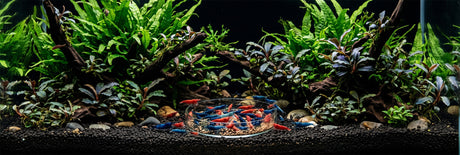
If you ask experienced shrimp breeders about the most important component of their setup, the answer is almost always: moss. Mosses are much more than just pretty decorations. They form the biological foundation of a stable invertebrate tank and are almost essential for the well-being of shrimp.
In this article, you will learn why mosses function as "nurseries," which species grow most beautifully, and how you can cultivate them without frustration.
The 3 Essential Benefits of Moss for Shrimp
1. The Inexhaustible Pantry
Due to their fine structure, mosses have a huge surface area. Masses of microorganisms and bacteria, the so-called biofilm, settle on these tiny leaves. For shrimp, this growth is the most natural and important food source. Especially baby shrimp spend almost their entire first weeks of life protected within the mosses, continuously grazing on this biofilm.
2. The Safe Nursery
After molting or during gestation, shrimp seek protection. The dense cushions of mosses offer perfect hiding places. Juveniles can retreat deep into the thicket, where they remain invisible to predators (or curious tankmates).
3. Biological Filter and Oxygen Supplier
Mosses are extremely efficient waste recyclers. They absorb excess nitrate and phosphate directly from the water and simultaneously produce valuable oxygen. Thus, they actively contribute to the stability of your ecosystem.
The Most Popular Moss Species: An Overview
Depending on their growth form and appearance, there is a suitable moss for every layout. Here are the most common varieties:
- Java Moss (Taxiphyllum barbieri): The indestructible classic. It grows under almost all conditions, is very fast-growing, and forms dense, rather irregular tufts.
- Christmas Moss (Vesicularia montagnei): It owes its name to its triangular shoots, which hang downwards like small Christmas trees. It looks very tidy and elegant.
- Flame Moss (Taxiphyllum sp. 'Flame'): A visual highlight! The shoots grow strictly upwards in a spiral, resembling flickering green flames. Ideal for vertical accents.
- Phoenix Moss (Fissidens fontanus): One of the most beautiful mosses. It forms very fine, feathery cushions that look almost like small underwater ferns. It grows slower and thus appears very compact.
- Weeping Moss (Vesicularia ferriei): This moss grows in a weeping habit (like a weeping willow). It is perfect for "greening" roots or stone edges, as it gently covers hard contours.
Moss Cultivation Made Easy: The ShrimpPuddle Solution
As beautiful as mosses are, attaching them in the aquarium can be nerve-wracking. Who hasn't been annoyed by slippery nylon threads or sticky fingers from superglue? Additionally, detritus and food residues often accumulate in tightly bound moss balls, which are difficult to remove.
This is where our ShrimpPuddle moss pads come in. They make moss care a breeze:
- Easy Insertion: Instead of tedious tying, you simply place the moss into the tray of the pad and close the lid.
- Clean Look: The moss grows evenly through the grid and forms a perfect cushion, without visible glue edges or threads.
- Flexible Care: Do you want to trim the moss? Simply remove the pad from the tank, trim it over the sink, and put it back in. This prevents hundreds of small moss fragments from floating through your aquarium and growing in unwanted places.
- Height Adjustable: Our pads adapt to the moss species – whether flat Phoenix moss or voluminous Christmas moss.
Conclusion: Green Oases for Vital Shrimp
Mosses are the key to a vibrant and healthy shrimp aquarium. They provide food, protection, and improve water quality. With the right species and the uncomplicated handling provided by ShrimpPuddle moss pads, nothing stands in the way of a beautifully growing underwater jungle.