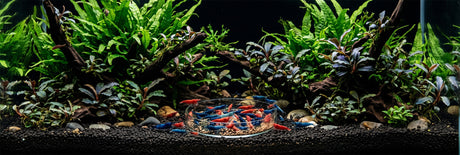
You buy beautiful new shrimp, place them in your perfectly running tank – and after a few days, the mass dying begins. Either the new animals are affected, or even worse, your established colony. Often, the cause is not a classic disease, but a bacterial incompatibility (BI). In this article, we explain the biological background and how you can protect your animals from it.
What exactly is bacterial incompatibility?
The term is essentially a simplification. It's not an "allergy," but rather a clash of different bacterial strains. Every aquarium has its own specific microflora – a kind of "bacterial fingerprint." The shrimp in this tank have an immune system perfectly adapted to these specific bacteria. When you buy new animals from a different breeding facility, they bring their own bacteria with them.
The problem:
- Your old colony does not know the bacteria of the new animals.
- The new animals do not know the bacteria of your old colony.
- The immune system of both groups can be weakened by transport stress and is now flooded with "unknown" germs. The result is an infection wave that often ends fatally.
Digression: How does a shrimp's immune system work?
Unlike humans, shrimp do not possess an adaptive immune system. This means they cannot form antibodies against specific pathogens and cannot develop a "memory" for diseases. Shrimp rely on their innate immune system. This functions more like a non-specific defense:
- Phagocytosis: Special cells (hemocytes) simply engulf foreign bacteria.
- Melanization: Pathogens are encapsulated and rendered harmless by pigments (often visible as dark spots after injuries).
- Antimicrobial Peptides: The shrimp secretes proteins that directly kill bacteria.
This system is very effective, but quickly overloaded by stress or a massive influx of germs.
Prevention and Help: How to protect your shrimp
If incompatibility occurs, quick action is required. The goal must be to reduce the germ density and strengthen the animals' immune defenses.
1. The power of humic substances
Humic substances (found in alder cones, catappa leaves, or liquid concentrates) are nature's "gentle medicine."
- They have antibacterial and fungicidal (anti-fungal) effects.
- They gently tan the animals' mucous membranes, making it harder for bacteria to penetrate the body.
- They reduce the germ density in the free water without harming beneficial filter bacteria.
2. Targeted immune strengthening with GlasGarten ShrimpFit
GlasGarten ShrimpFit
This special feed contains active ingredients such as beta-glucans and mannan-oligosaccharides. These substances "trick" the immune system into thinking there's an infection, putting the defense cells on high alert.
An absolute insider tip in the breeder scene is GlasGarten ShrimpFit.
- The effect: The defense cells patrol the body more actively.
- Application: Especially before and after adding new animals, ShrimpFit helps to boost the body's own defenses so that foreign bacteria can be rendered harmless immediately.
Checklist for new stocking
- Quarantine: If possible, acclimate new animals in a separate tank.
- Slow adaptation: Use the drip method over several hours.
- Reduce germ density: A large water change before introducing them reduces the existing bacterial load.
- Support: Add humic substances to the tank and feed ShrimpFit two days beforehand to "boost" the immune system.
Conclusion: Preparation is everything
Bacterial incompatibility is a serious risk, but with knowledge of the shrimp's immune system, it loses its terror. By combining stress avoidance, the natural power of humic substances, and immune-stimulating food, you create the best conditions for your animals.