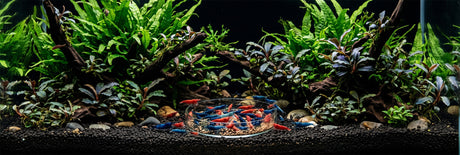
Hardly any snail polarizes as little and delights as many as the ramshorn snail. Anyone who has seen one in a well-established aquarium – gliding in brilliant red, deep blue, or delicate pink over lush green plants – immediately understands why it has been one of the most popular invertebrates in aquaristics for decades. It is not only beautiful but also useful, robust, and suitable for practically every type of tank.
Origin and Wild Form: Where Does the Ramshorn Snail Come From?
The great ramshorn snail (Planorbarius corneus) is a native species and is widespread in slow-flowing or standing waters in Europe, West Asia, and North Africa. It was once the classic aquarium snail – until tanks became warmer due to modern technology and it simply became too hot for it.
The colorful ramshorn snails commonly found in aquaristics today predominantly belong to the species Planorbella duryi, originally from Florida and California (USA), possibly also to the related Helisoma cf. anceps or to Asian species that were introduced with aquatic plants. Precise species identification is difficult due to decades of cross-breeding in aquaristics – but this hardly plays a role in practice.
The wild form shows a brown-transparent, flatly coiled shell and a brown body. One thing makes the ramshorn snail biologically unique among freshwater snails: it possesses hemoglobin instead of hemocyanin – the same red, oxygen-binding protein as humans. This explains why many animals and their body fluids appear vibrantly red.
A Rainbow in the Aquarium: The Common Color Variants
The coloration of the ramshorn snail always results from the combination of two factors: the shell color (white, yellow, brown, or transparent) and the color of the shimmering body. This combination allows for an astonishing range:
- Red: Red body with yellowish shell – probably the best-known and most commonly kept variant.
- Pink: Red body combined with a white shell – appears delicate and pastel-colored.
- Blue: Dark body under a white shell – a real eye-catcher and highly sought after in aquaristics.
- Orange / Apricot: Warm intermediate tones created by mixing a reddish body and a slightly tinted shell.
- Golden / Turquoise: Rarer cultivated forms that have emerged through targeted selection.
- Brown (Wild form): Brown body, brown-transparent shell – inconspicuous, but the most natural variant.
All color forms have arisen through breeding and have been selected to be genetically stable – however, they will intermix if different variants are kept together, as they readily mate with each other.
Water Parameters: What the Ramshorn Snail Really Needs
Ramshorn snails are surprisingly tolerant, but they have one clear weakness: water that is too soft or acidic. In such an environment, the shell begins to corrode – it becomes porous, white, and brittle. The snail can repair internal damage, but the appearance suffers permanently.
- Temperature: 18–28 °C
- pH value: 7.5–8.5 – a slightly alkaline environment promotes healthy shell formation
- GH: 10–20 °dH – sufficient calcium is crucial
- KH: 5–15 °dH
- Conductivity: 250–750 µS
Important: Ramshorn snails are lung snails and must regularly come to the water surface to breathe. The tank should therefore not be hermetically sealed.
The Right Tank: Size, Setup & Design
Ramshorn snails are exceptionally uncomplicated when it comes to their tank – and that's precisely what makes them so universally applicable. A small group of 5–10 animals can be kept without problems in tanks from 30 liters, for a representative display tank with mixed color variants, 54 liters and upwards are recommended.
There are hardly any limits to the design. Ramshorn snails thrive in almost any tank type:
- Naturally planted: Dense planting with Anubias, mosses, fine-leaved plants, and floating plants offers optimal grazing grounds throughout the day. The more surface area, the happier the snails.
- Aquascape style: Ramshorn snails also look excellent in a clean, designed scape – the color variants create deliberate accents on stones and roots.
- Substrate: At least partially sand or fine gravel, so that the snails can also search for food remnants on the bottom.
Ramshorn snails get along well with shrimp, crayfish, and most fish species. Only snail-eating species like pufferfish or large cichlids should be avoided.
Nutrition: More Than Just an Algae Cleaner
Ramshorn snails are rightly considered all-rounders among aquarium caretakers. They graze algae film from glass, stones, and plant leaves, eat dead plant material, and process organic residues on the substrate. But for their shells to remain stable and the animals vital, active support is needed.
GlasGarten Mineral Junkie Bites
These mineral-rich food sticks are specially designed to meet the needs of snails and crayfish. The high calcium content directly supports shell formation and prevents corrosion – especially important in medium-hard or softer water.
GlasGarten Snail Dinner
Our Snail Dinner is a balanced staple food specifically for snails – with a nutrient profile that precisely covers the needs of ramshorn snails for protein, minerals, and fiber.
Catappa leaves are an excellent natural supplement in a snail aquarium. The leaves are actively grazed by ramshorn snails, release valuable humic substances into the water, and promote the formation of a nutritious biofilm on their surface – virtually a natural snack and water conditioner in one.
Reproduction: Hermaphrodites with Plenty of Speed
Ramshorn snails are hermaphrodites – each animal carries both sexes and can even self-fertilize in an emergency. In practice, however, they prefer to mate with conspecifics. The egg clutches are laid as flat, oval gelatinous discs containing 10–20 eggs on plants, stones, or the aquarium glass and are clearly visible after a few days. Under optimal conditions and with sufficient food, the population can grow rapidly – if you want to control this, simply reduce the feeding amount.
What Makes Them So Special: Color Meets Function
The ramshorn snail is the perfect combination of aesthetic eye-catcher and practical clean-up crew. While other snails often work inconspicuously in the background, the ramshorn snail, with its variety of colors, actively sets visual accents in the tank. No other invertebrate offers such a comparable range of colors in this price segment – from elegant dark blue to radiant red. At the same time, it is robust, adaptable, and compatible with shrimp, crayfish, and most fish species.
Conclusion: Small, Colorful, Indispensable
The ramshorn snail is not an accidental resident for the aquarium – it is a conscious decision for more color, more life, and less algae work. With the right water parameters, adequate calcium supply, and some natural leaves, it feels completely at home and rewards you with a splendor of colors that hardly any other snail species can offer.