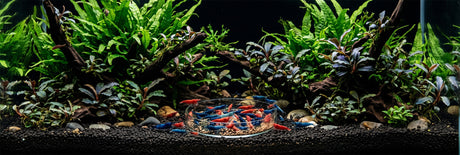
There are shrimp that you keep. And then there's the Sulawesi Cardinal Shrimp. Caridina dennerli is not a beginner's project – it's the goal. Deep ruby red, white spots like scattered stardust, snow-white claws: this shrimp looks like someone placed a jewel in the aquarium. Anyone who has observed it in a well-established Sulawesi tank immediately understands why it is one of the most sought-after dwarf shrimp in the world – and why its demands are justified.
Origin: Endemic to a single lake
The Cardinal Shrimp is not a cosmopolitan. It occurs exclusively in Lake Matano worldwide – one of the five Mallili Lakes in the south of the Indonesian island of Sulawesi. Lake Matano is one of the deepest lakes in the world and, due to its geographical isolation, is an ecological unicum: the water is extremely low in nutrients, almost germ-free, and of crystal-clear purity. Water values hardly change throughout the year – stability here is not a bonus, but a law of nature.
In the lake, Caridina dennerli resides in the rocky shore area, where it spends the entire day grazing on the algal growth on the stones. No dense plant beds, no soft substrates – just rock, clear water, and light. This knowledge is crucial for species-appropriate keeping in an aquarium.
Water values: The decisive difference
The Cardinal Shrimp is non-negotiable when it comes to water values. Those who cut corners or are sloppy here will lose their animals. The water should ideally consist of osmosis water, brought to the correct parameters with a hardening salt specially developed for Sulawesi shrimp.
- Temperature: 27–30 °C – consistently warm, no fluctuations
- pH value: 7.5–8.5 – slightly alkaline
- GH: 7–10 °dH
- KH: 1–7 °dH – keep consciously low
- Water quality: Low in germs, free of heavy metals and pollutants
Weekly water changes of at least 30–50% are mandatory – not as a routine, but as active health prevention. The water must always be pre-warmed to exactly tank temperature before being added.
The right tank: Setup for a Sulawesi habitat
A Cardinal Shrimp tank starts at 20 liters for a small group, but at least 30–54 liters are recommended so that a group of 10–15 animals has enough space and grazing area. More volume means more stable water values – and stability is everything with this species.
The setup is directly based on the model of Lake Matano:
- Hardscape: Dark lava stones, porous volcanic rocks, or smooth river stones form the basic structure. Many surfaces and interstices are more important than visual splendor. The shrimp systematically graze every stone.
- Substrate: Dark fine sand or dark gravel – optimally highlights the ruby colors of the animals and corresponds to the natural lakebed.
- Plants: Classic aquascaping plants almost always fail in this tank due to the combination of 28–30 °C and the specific mineral content. What works excellently: Mosses (Java Moss, Mini Christmas Moss, Weeping Moss) and especially Bucephalandras, which thrive under these parameters, require little light, and offer additional grazing areas for the shrimp.
- Filter: A Hamburg mat filter or a fine sponge filter is ideal – no suction that could draw in juveniles.
Feeding: Biofilm and powdered food instead of food sticks
Anyone who wants to feed Cardinal Shrimp with normal shrimp sticks or food chips will be disappointed: the animals actively graze on growth and biofilm from stone surfaces all day long. They often don't even accept large pieces of food – or only when they have already disintegrated and become fine particles. The consequence: powder and powdered food are not an option here, but the only sensible choice.
GlasGarten Bacter AE
The micropowder activates a dense, nutritious biofilm on all stone surfaces and throughout the entire tank – exactly what Cardinal Shrimp graze on all day in their natural habitat. It is the most nutrient-rich and natural basic supply you can offer your animals.
GlasGarten Shrimp Baby Food
The ultra-fine powdered food immediately dissolves into tiny particles when sprinkled, which float throughout the entire water volume. Cardinal Shrimp absorb it directly from surfaces and from the water column while actively grazing – significantly more efficient than any pad or stick.
Socialization: Less is definitely more
The Cardinal Shrimp remains very small, at a maximum of 1.5–2 cm, making it easy prey for almost any fish. Socialization with fish should be fundamentally rejected – even seemingly peaceful species will sooner or later become a problem.
What fits excellently: Tylomelania snails. The majestic elephant snails from Sulawesi share the same water parameters and needs, do not compete for food, and enliven the tank with their slow, deliberate presence. A combination that is visually and biologically convincing. Other Sulawesi dwarf shrimp, such as the Blue Leg Poso Shrimp (Caridina caerulea), are also compatible inhabitants.
Hiding places: A basic need, not a luxury
Cardinal Shrimp require more hiding places than most other dwarf shrimp. In their natural habitat, rock crevices and stone caves provide permanent protection – in the aquarium, this protection must be actively recreated. Especially after molting and during stress, the animals immediately seek out narrow, dark shelters.
ShrimpPuddle Baby Flat Tube
The flat tubes are specially designed for small and sensitive shrimp. They offer narrow, natural-looking retreats that Cardinal Shrimp immediately and intensively accept. Optimal as a supplement to rock structures in a Sulawesi aquarium.
Breeding forms: When selection surpasses nature
The classic Cardinal Shrimp – luminous red, white spots, white claws – is already an exceptional animal. But aquaristics has not stood still. Through targeted selection, some remarkable breeding forms have emerged in recent years:
- Blue Ghost: By reducing the red pigment, a deep blue to black-blue variant with the same characteristic spot pattern was created – one of the most sought-after breeding forms ever.
- Galaxy: Black body with white to light blue dots – looks like a starry sky underwater.
- Tigris: Red-white or brown-white striped pattern instead of dots – a visually completely different pattern that hardly reveals any connection to the wild form.
All breeding forms place the same high demands on keeping and water quality as the wild form – those who invest here should already have a stable and established setup.
Conclusion: An animal for enthusiasts – rightly so
The Sulawesi Cardinal Shrimp is not an animal for the impatient. It demands stable chemistry, germ-free water, the right diet, and a tank without fish. Those who offer all of this will be rewarded with one of the most colorful and fascinating invertebrates that aquaristics has to offer – and with the quiet pride of keeping one of the world's rarest habitats alive in their own living room.