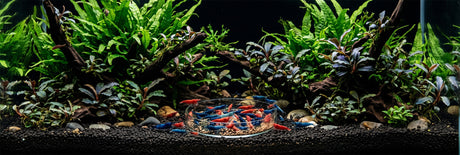
Invertebrate aquarists often ask: Which fish are compatible with my shrimp without the offspring becoming prey? The answer lies in the smallest representatives of the genus Corydoras.
We're talking about dwarf corydoras. In this article, we'll introduce you to the Checkered Dwarf Corydoras (Corydoras habrosus) and the Dwarf Corydoras (Corydoras pygmaeus) in more detail and explain why they form the perfect "team" with your shrimp.
The Stars in Profile: Origin and Appearance
Both species originate from South America, but inhabit different niches in the tributaries of large river systems such as the Orinoco or the Amazon.
1. Corydoras habrosus (Checkered Dwarf Corydoras)
- Appearance: It looks like a "classic" corydoras in miniature. It has dark spots on a light background, reminiscent of a checkerboard pattern.
- Behavior: It is extremely bottom-oriented. It spends the day sifting through the sand for food.
- Size: It grows to about 2 to 3 cm.
2. Corydoras pygmaeus (Dwarf Corydoras)
- Appearance: More simply colored with a distinctive dark longitudinal stripe on a silvery background.
- Behavior: The special feature of this species is that it spends a lot of time free-swimming. They often swim in schools through the middle of the aquarium, which is rather untypical for corydoras.
- Size: At about 2 cm, it remains a bit smaller than the habrosus.
Why They Are the Perfect Partners for Shrimp
The combination of shrimp and dwarf corydoras is a "match made in heaven" for several reasons:
1. Peacefulness and Safety for Offspring
Dwarf corydoras are absolutely peaceful schooling fish. Their mouths are anatomically designed to sift the smallest food particles from the substrate. Unlike tetras or barbs, they generally do not actively pursue shrimp offspring. A baby shrimp sitting directly in front of them is usually simply ignored.
2. Similar Water Parameter Requirements
Both species love soft to medium-hard water and temperatures between 22 °C and 26 °C – exactly the range in which most Neocaridina and many Caridina species also thrive.
3. No Competition, but Complementary
While shrimp clean moss and surfaces of algae, the catfish take care of the smallest food remnants in the sand. They keep the substrate moving and thus prevent stagnant spots.
Keeping and Feeding in the Aquarium
Aquarium Size and Setup
- Tank size: Due to their small size, both species can be kept in aquariums starting from 54 liters (60 cm edge length). We advise against permanent keeping in 30-liter cubes, as they are schooling fish (at least 8-10 animals) and require swimming space.
- Substrate: Fine sand is an absolute must. The catfish "root around," meaning they filter the sand through their gills. Coarse gravel would injure their sensitive barbels.
What's on the Menu?
Dwarf corydoras are omnivores with a preference for meaty food.
- Fine granules: Make sure the particles are very small and sink quickly to the bottom.
- Frozen food: Cyclops, Artemia nauplii, or fine daphnia are loved.
- Minerals: Catfish also benefit from a good mineral supply for their bony plates. GlasGarten Mineral Junkie Bites are often nibbled on by catfish when they soften.
Conclusion: Vivacity Without Stress
If you want to complement your shrimp tank with a fish species without endangering the safety of the shrimp, Corydoras habrosus and pygmaeus are just right. They bring life to the middle and lower tank zones, are easy to care for, and harmonize beautifully visually with colorful shrimp strains.