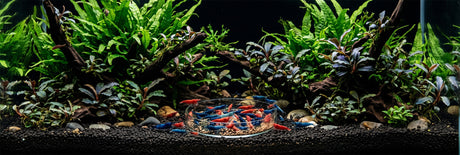
Anyone who seriously engages in breeding high-end shrimp such as Bee Shrimp, Taiwan Bees, or Boa will sooner or later come across a filter system that was long considered outdated in Europe, but in Asia forms the basis for worldwide breeding success: the undergravel filter.
In this article, you will learn why this system, in conjunction with active soil, is so unbeatable, how it works, and how you can perfectly complement it with modern solutions from ShrimpPuddle.
Origin: Perfection from the Far East
We owe the revival and perfection of the undergravel filter to Japanese and Taiwanese shrimp breeders. In the large breeding facilities in Asia, they faced the challenge of keeping thousands of animals in relatively small tanks with extremely stable water parameters.
The solution was not an ever-larger external filter, but the use of the largest available filter medium in the aquarium itself: the substrate.
How does an undergravel filter work?
The principle is as simple as it is ingenious. A grid (the undergravel filter plates) is laid under the substrate, connected via a riser pipe to an air pump (airlift) or a small centrifugal pump.
- The principle: Water is drawn down through the entire substrate, collected under the plates, and returned to the tank via the riser pipe.
- The effect: Your entire soil substrate becomes a huge, biological filter. Billions of beneficial bacteria settle on the countless pores of the soil. The result is a water quality that is difficult to achieve with conventional internal or external filters.
The "Turbo Effect" in combination with active soil
Undergravel filters are almost exclusively operated in breeding setups with active soil. There's a specific reason for this: The permanent flow through the soil constantly guides the water past the ion-exchanging particles.
- Faster buffering: The pH value and carbonate hardness are stabilized much faster and more evenly to the target value.
- No stagnant areas: Since the substrate is permanently permeated by oxygen-rich water, no anaerobic zones (foul spots) can develop, which would be fatal for sensitive shrimp.
- Germ reduction: The huge biological surface ensures an extremely low germ density in the free water – the basic prerequisite for the survival of baby shrimp.
Application: The Pro Setup for Rare Shrimp
Undergravel filters are primarily found in pure breeding tanks. Since plant roots can grow very strongly and clog the grid in this system, it is less suitable for heavily planted aquascapes. But for anyone focusing on the reproduction and vitality of their shrimp, it is the system of choice.
The perfect complement: ShrimpPuddle Soil Background
A disadvantage of the classic undergravel filter is that the soil, due to the permanent flow, becomes saturated faster and loses its buffering capacity. Normally, you would then have to completely re-establish the tank.
This is where the smart combination comes in: You can operate your tank with an undergravel filter and a thin layer of neutral gravel or already exhausted soil (for aesthetics and bacterial colonization) and control the active water influence completely via our ShrimpPuddle Soil Background.
- The advantage: The undergravel filter provides a huge biological surface and clear water, while the Soil Background on the back wall buffers the pH. When the soil in the background is exhausted, you replace it in seconds, without disturbing the delicate biological balance of your undergravel filter.
Conclusion: Maximum Stability for Your Breeding
The Asian undergravel filter is the heart of many successful breeding facilities. It offers unparalleled biological safety. In combination with the ShrimpPuddle Soil Background, you also eliminate the biggest weakness – the elaborate re-establishment when the soil is exhausted.
Create the perfect environment for your rarities and rely on technology that has proven itself with professionals worldwide.