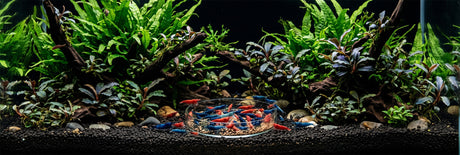
Among terrarium inhabitants, they have triggered a real hype in recent years: crabs of the genus Geosesarma. With their vibrant colors, often striking yellow eyes, and compact size, they are ideal inhabitants for small, humid habitats.
But what makes keeping these Indonesian land crabs so special, and how can you create a piece of Borneo in your own home?
Their Home: Hidden Habitats on Borneo and Java
Most Geosesarma species originate from the islands of the Malay Archipelago, particularly Borneo and Java. Contrary to what many beginners assume, they do not live in the sea or large rivers.
The Local Habitat:
- Forest edges and jungle floors: They inhabit the humid leaf litter and banks of small forest streams.
- Semi-aquatic: Geosesarma are land crabs that, despite having gills, spend most of their lives on land. They only need a shallow water dish or a small water section to moisten their gills and for molting.
- Masters of concealment: In nature, they live in small burrows they dig themselves or under decaying wood and stones, always where humidity is extremely high.
Species Diversity: How Many Are There?
The genus Geosesarma currently includes over 50 described species, with new variants regularly being discovered. Many of these are endemic, meaning they occur worldwide only in a very limited valley or forest section.
The Most Common Species in the Hobby:
- Geosesarmadennerle (Vampire Crab): The classic with a deep purple carapace and a yellow spot on its back.
- Geosesarmahagen (Red Devil): Distinguished by a vibrant reddish-orange and dark claws.
- Geosesarmasp. „Tioman“: A slightly smaller, often bluish-gray variant.
Keeping in a Terrarium: A Piece of Rainforest
Since Geosesarma are social animals, it is best to keep them in small groups (e.g., 1 male to 2-3 females).
- Terrarium size: A standard terrarium of 35-50 cm in length is sufficient for a small group.
- Setup: Plenty of moss, leaves (e.g., Indian almond leaves), and cork tubes are a must. As they like to climb, the terrarium should be structured.
- Climate: Temperatures between 24 °C and 28 °C and humidity above 80% are ideal. Daily spraying with decalcified water is essential for their well-being.
- The water section: A shallow dish with fresh water is sufficient. Important: The crabs must be able to climb out easily, as paradoxically, they can drown if they cannot find an exit.
Diet: Small Omnivores with an Appetite
Geosesarma are opportunistic omnivores. In nature, they feed on insects, larvae, and fallen fruits.
Feeding Recommendations:
In the terrarium, a varied diet is key to success:
- Frozen and live food: Frozen food (e.g., red mosquito larvae) or small insects such as springtails and white isopods (which also serve as a "cleaning crew" in the terrarium).
- Special food: High-quality granules for crustaceans.
- Vitamins & Minerals: To support their carapace, mineral supplement additions (such as Mineral Junkie Bites) are also highly recommended for crabs to prevent molting problems. Leaves should also not be forgotten as a food source here.
Why Are They So Popular?
The appeal of Geosesarma lies in their complete development in freshwater and on land. Unlike many other crab species (such as the terrestrial hermit crab), whose larvae must grow in seawater, fully developed, tiny juvenile crabs hatch directly in the terrarium with Geosesarma. This makes them one of the few crab models that can be bred relatively easily in a home paludarium.
Moreover, their small size and interesting social behavior make them extremely exciting for observers in a small space.
Conclusion: Colorful Exotics for Nature Lovers
Geosesarma crabs bring color and life to any rainforest terrarium. Anyone who ensures high humidity, sufficient hiding places, and a protein-rich diet will enjoy these small "vampires" from Borneo. They are perfect proof that you don't need a huge aquarium to keep fascinating invertebrates.